

ADHD, Sound Processing, and the Hidden Work of Listening

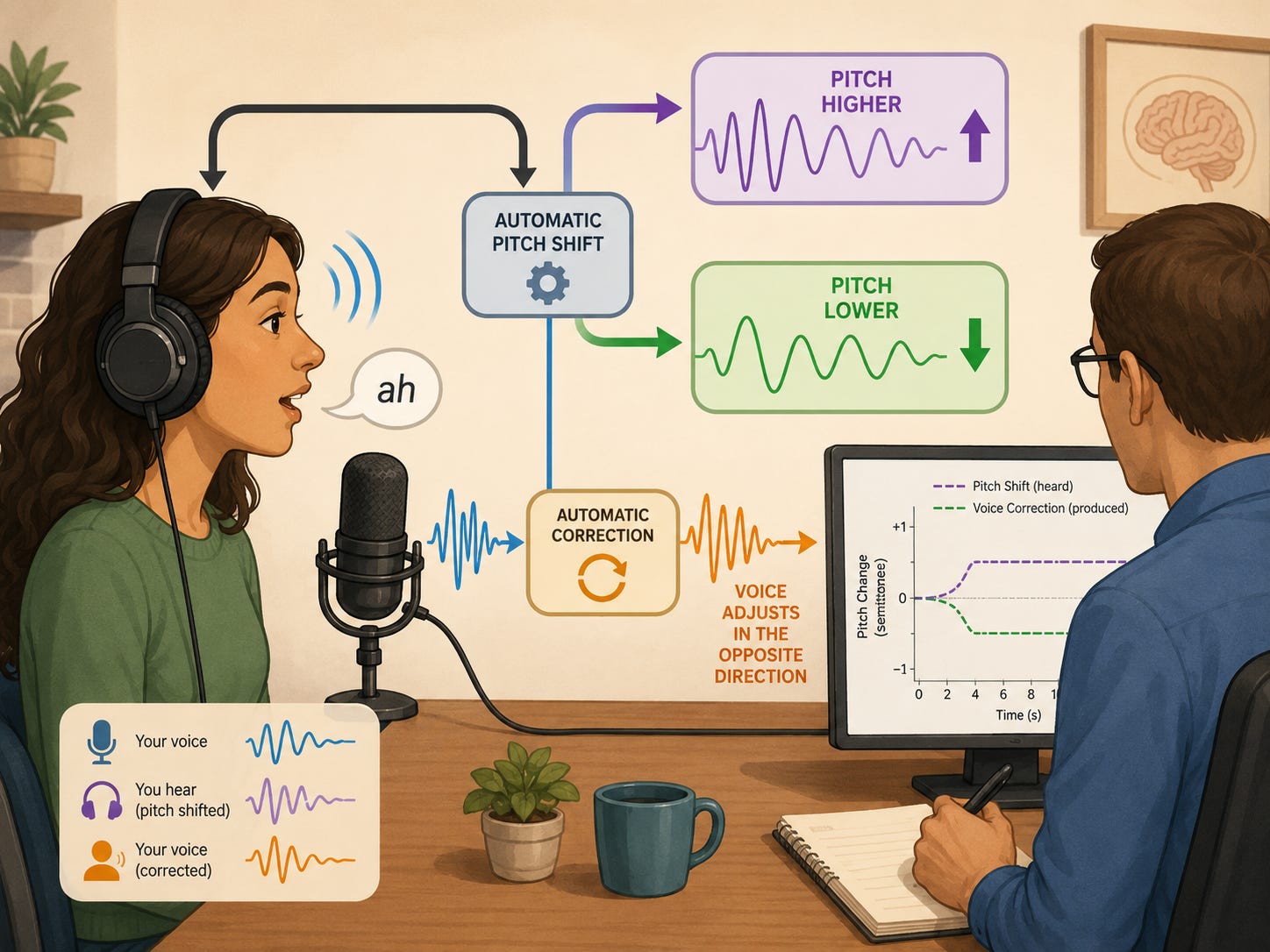
This thesis looked at whether ADHD traits are connected to differences in auditory processing and speech motor control.
In plain language, the researcher was asking:
How does the ADHD brain use sound while speaking?
When we speak, we do not just send words out.
Our brain is also listening to our own voice and making tiny corrections as we talk.
If your voice comes out a little too high, too low, too soft, too loud, or slightly different from what your brain expected, your auditory system can help correct it almost instantly.
That correction process is called feedback control.
But speech is not only feedback.
Your brain also uses learned speech patterns. You do not have to think about how to move your tongue, lips, jaw, and voice every time you say a familiar word. Your brain already has speech plans stored.
That automatic system is called feedforward control.
So good speech uses both systems.
Feedback helps you adjust in the moment.
Feedforward helps speech feel smooth and automatic.
The researcher wanted to know whether ADHD traits, especially attention and sensory processing, change how much people rely on sound feedback versus automatic speech plans while speaking.
What They Studied
The thesis included three parts:
a review of research on auditory brain responses in ADHD
a study of children looking at attention, sensory processing, and vocal control
a study of adults with and without ADHD looking at speech motor control and brain responses
The key idea was that ADHD is not only about attention.
ADHD can also involve differences in sensory processing, auditory processing, motor control, speech and language patterns, working memory, inhibition, and processing speed.
That matters because speech depends on the brain’s ability to use sound information.
The brain has to decide:
Do I need to correct what I am hearing right now?
That is feedback.
Or:
Can I rely on the speech pattern I already know?
That is feedforward.
So when someone with ADHD struggles to follow speech, tolerate noise, stay regulated in loud places, or respond quickly to what they hear, it may not be only because they are distracted.
Their brain may also be working harder to process sound.
What They Actually Did
The researcher used something called a frequency-altered feedback task.
That sounds complicated, but the idea is simple.
Participants spoke while hearing their own voice through headphones. Then the researchers slightly changed the pitch of what the person heard.
So the person might say “ah,” but hear their voice shifted a little higher or lower.
Then researchers measured whether the person’s voice automatically corrected in response.
If the person made a bigger correction, that suggested they were relying more on feedback control.
In other words, their brain was listening closely to the live sound of their voice and adjusting.
If the person made a smaller correction, that suggested they may have been relying less on live sound feedback and more on feedforward control.
In other words, their speech may have been running more on learned, automatic speech plans.
What They Found About ADHD and Sound Processing
The review part of the thesis found that people with ADHD often show differences in brain responses to sound.
The clearest differences were in later brain responses called N200 and P300.
The practical meaning is this:
The ADHD brain may process sound differently, especially when the brain has to notice, evaluate, or respond to a sound.
That fits with what many ADHD people describe in real life:
“I heard you, but I didn’t process it.”
“I can’t follow conversations in noisy rooms.”
“Background noise makes it impossible to think.”
“I need people to repeat themselves.”
“Listening takes effort.”
The Most Useful Finding
The most useful finding was that sensory processing mattered more than attention.
In the child study, attention did not predict how strongly children corrected their speech. Sensory processing patterns did.
Children with more sensory processing differences showed larger vocal corrections.
That means they may have relied more strongly on feedback control.
Their brains may have been using the live sound of their own voice more heavily and making bigger adjustments.
In the adult study, sensory processing also mattered more than attention, but the pattern was different.
Adults with more sensory sensitivity, sensory avoidance, or low registration tended to show smaller vocal corrections.
That may mean they relied less on live auditory feedback and more on feedforward control.
Their speech system may have been running more on automatic speech plans.
That sounds confusing at first, but it may reflect development.
Children are still building speech motor systems, so sensory differences may make them rely more on feedback.
Adults have more established speech patterns, so they may depend more on feedforward control: the automatic speech plans they have already learned.
What This Does Not Mean
This does not mean people with ADHD have poor speech motor control.
In fact, the thesis found that adults with ADHD had largely intact speech motor abilities.
The brain responses to sound were somewhat different, but their actual speech correction behavior was mostly similar to adults without ADHD.
ADHD may involve differences in how sound is processed, and sensory processing may shape how the brain balances feedback and feedforward while speaking.
Why This Matters
This matters because ADHD support still too often focuses only on attention, motivation, and behavior.
But this study points to a more specific question:
How is the ADHD brain using sound information?
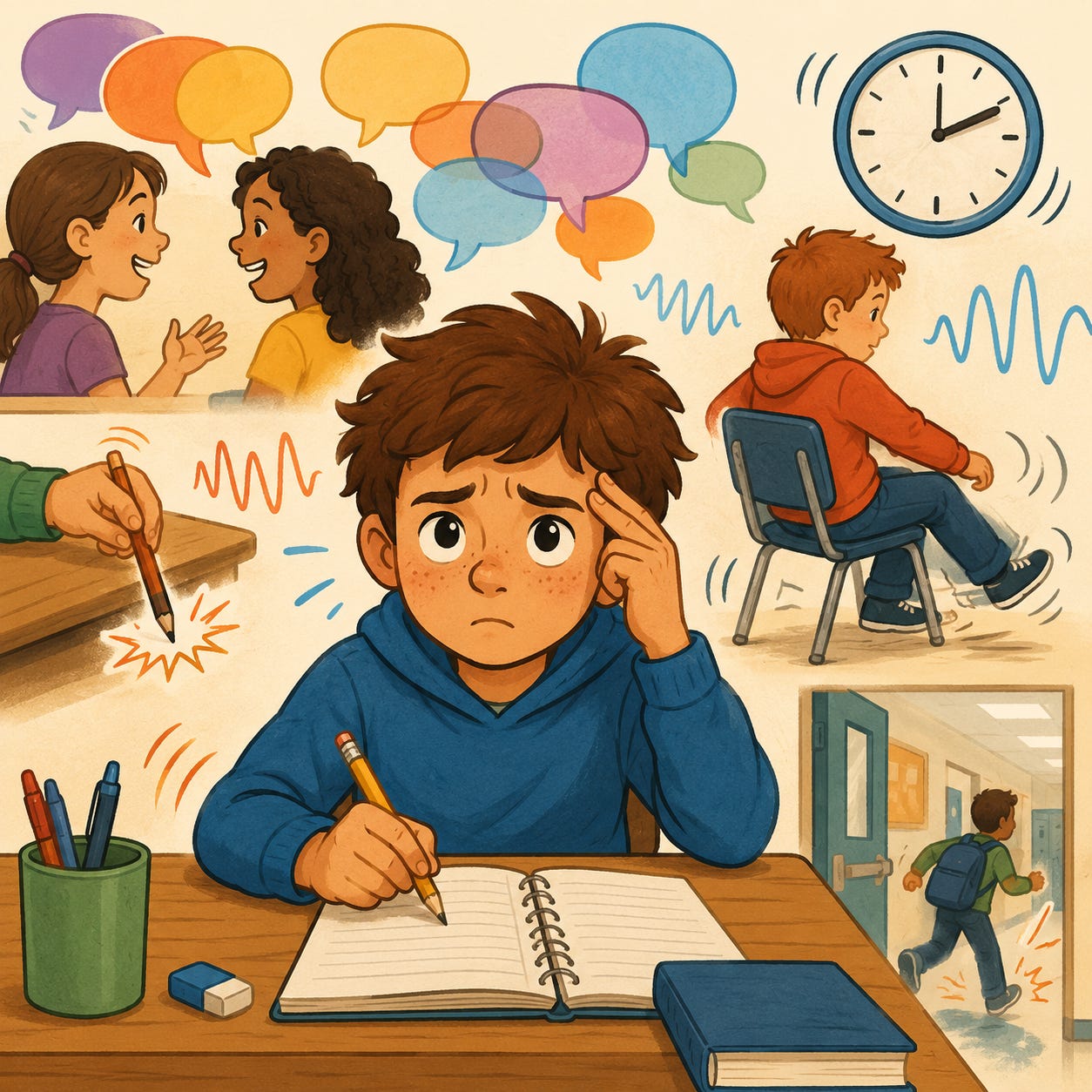
A child who does not follow instructions in a noisy classroom may not needto move her desk closer to the teacher. She may need less noise, clearer directions, written backup, or a quieter place to process.
An adult who struggles in meetings may not simply be distracted.
They may be trying to track speech, filter background noise, process meaning, remember what was said, and stay regulated at the same time.
Better support starts when we stop asking only:
“Are they paying attention?”
And also ask:
“How is their brain processing sound?”
Practical Takeaway
When a child, client, or adult with ADHD seems distracted, it may help to ask a different question:
How is their brain processing sound?
This research suggests that sensory processing may influence how the brain uses auditory feedback during speech.
That changes the support.
Helpful supports may include:
reducing background noise
giving written instructions
using captions or transcripts
allowing processing time
checking comprehension without shame
avoiding rapid-fire verbal directions
using quiet spaces for important conversations
recognizing auditory fatigue as real
The point is simple:
When ADHD people struggle to listen, follow speech, or process verbal information, it may not be only an attention problem. The auditory environment may be part of the demand.
Source
Bishai, R. (2026). An examination of speech motor control and auditory processing in attention deficit hyperactivity disorder (ADHD) [Master’s thesis, Wilfrid Laurier University]. Scholars Commons @ Laurier. https://scholars.wlu.ca/etd/2932
I hope you enjoyed this edition of the ADHD Advocate.
Share it or comment if you did!
Kristen McClure MSW, LCSW
great writing - i work as a secondary school teacher and can see this in action in my classroom every day
This was extremely helpful and interesting. I have ADHD & APD, fortunately were diagnosed when I was in upper grades. It explains why seating up close wasn’t helpful (did little to reduce background noise).
As I’ve aged it’s become even more frustrating though, I miss so much, i have to lip read which involves relative eye contact and with middle grade students is SO hard (I’m an educator), I get so irritable about noises that I was starting to wonder if it was misophonia! But it’s really not specific or certain sounds. Just how crowded and challenging sound/noise gets. It’s very obvious in high-stim situations and I can deal, but when I even get irksome outside of them, so bothered.